



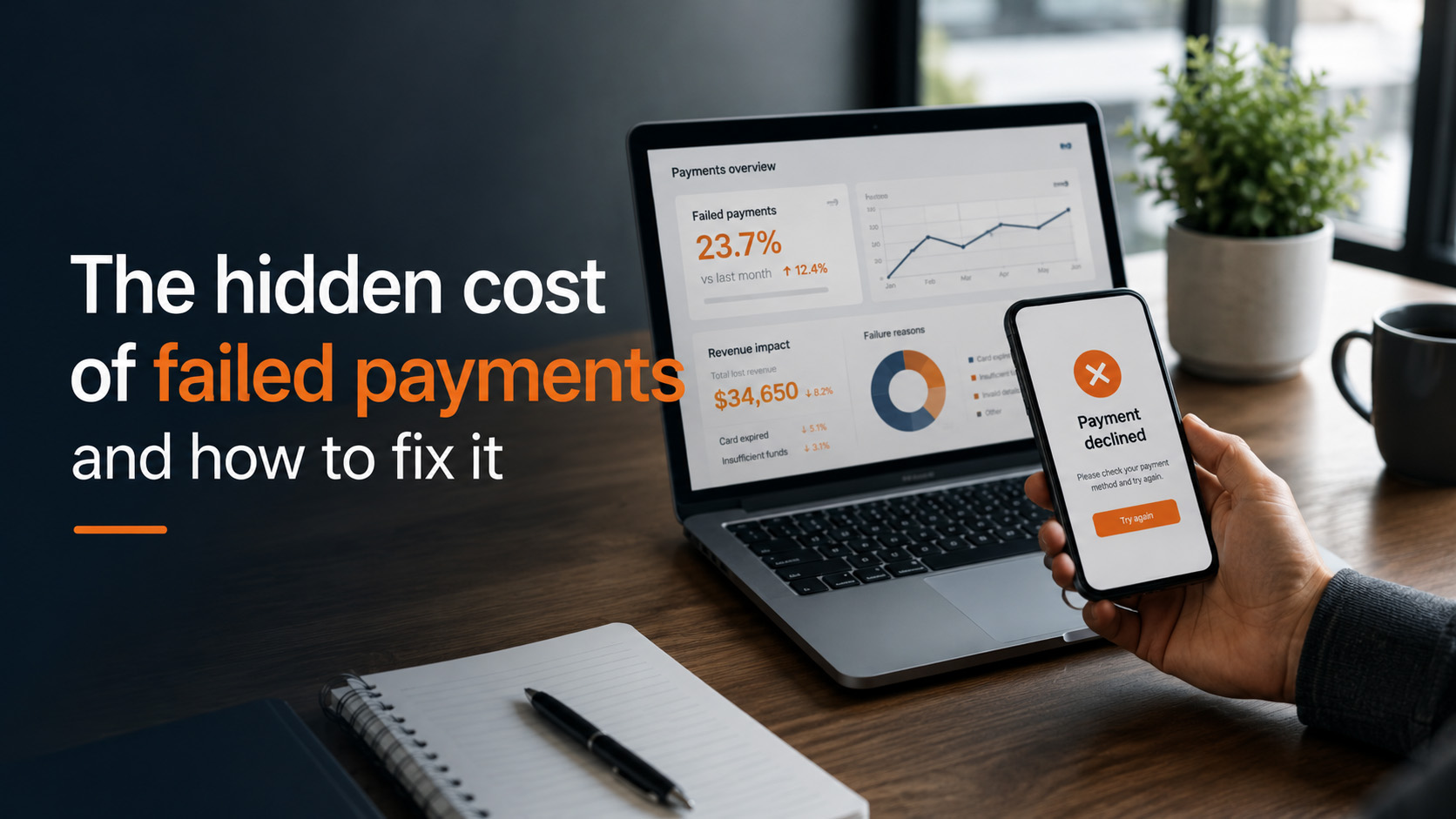
Failed payments are one of the biggest hidden revenue leaks in subscription businesses.
According to Recurly, failed payments could be costing businesses more than $129 billion USD in lost sales and revenues annually.
Failed payments have a habit of compounding into bigger, broader issues: lost revenue builds over time, cash flow becomes unpredictable, and teams spend more time chasing payments than growing the business.
Industry research shows failed payments are a major driver of involuntary churn, often caused by simple issues like expired cards or insufficient funds.
Most of this is preventable. Here’s how you can set your business up for success with properly implemented dunning management, preventing failed payment headaches and churn.
Why failed payments happen and their hidden costs
Failed payments are rarely random. They usually come down to a few common issues:
- Expired or replaced cards – cards can be lost, stolen or expired, and your customers might not remember to update your business with new details.
- Insufficient funds – APAC's cost of living crisis means that your customers might not have access to the funds they need when they need to make payments. Subscription services, like gyms, might seem like a luxury, and not something that is top of mind.
- Customers forget they are subscribed.
These are everyday problems. When at scale, they create a steady drain on revenue and cash flow complications. Left unmanaged, failed payments can account for a significant portion of churn in subscription businesses.
Why manual recovery does not scale
Many businesses try to manage failed payments manually – via phone calls, manual email correspondence, or over-the-desk interactions with customers.
That usually means sending reminders, retrying payments, and chasing customers. While these strategies work when you have a handful of customers, failed payment issues scale as your business grows.
Manual recovery is slow, inconsistent, and expensive. It also puts pressure on customer relationships, especially when follow-ups feel reactive. With exclusively manual processes, your team will spend far more time ‘chasing paper’ and not performing the tasks they actually want to (or need to) do in order to keep your business healthy.

Tools that help payment recovery
A better approach is to prevent failures where possible and recover them automatically when they happen.
Modern billing tools make this possible:
- Automated smart retries recover payments without manual effort
- Not all failures are equal, and retry timing needs to reflect that
- Soft declines (insufficient funds, temporary bank issues) often succeed on later attempts, especially when timed around salary cycles or typical account top-ups
- Hard declines (expired cards, closed accounts) require a different path, triggering update flows rather than repeated retries
- Smart retry logic uses issuer response codes, past behaviour, and local payment patterns to decide when and how often to retry
- Visibility and reporting
- Clear insight into failure reasons helps teams separate fixable issues from permanent ones
- Tracking retries, recovery rates, and churn risk highlights where optimisation is working and where it is not
- This visibility also feeds back into smarter retry strategies over time
- Card network tokenisation
- Keeps stored card details up to date automatically when cards are reissued or replaced
- Reduces failures caused by expired or changed card data without relying on the customer to take action
- Smart dunning workflows send timely reminders
- Communication timing is critical
- Immediate alerts can prompt quick fixes for forgotten payments, while spaced reminders avoid overwhelming the customer
- Messaging can be adapted based on failure type, payment method, and customer history to improve response rates
- Keeping multiple payment methods on file
- Provides a backup option when the primary payment method fails
- Reduces reliance on a single funding source and increases overall recovery rates
These tools reduce failed payments and remove friction from the experience. Automated dunning alone can recover a significant portion of failed payments that would otherwise be lost, but the real impact comes from combining it with intelligent retry logic.
Timing, failure type, and payment behaviour all play a role in whether a retry succeeds. When these elements are handled together, recovery becomes less about chasing payments and more about systematically capturing revenue that would have slipped through.

Reporting helps you stay ahead
You cannot fix what you cannot see, and this is where efficient reporting comes into play.
Clear reporting helps you:
- Track failed payments
- Identify patterns
- Spot at-risk customers early
Instead of reacting late, you can act early.
That shift makes a measurable difference to retention.
Card network tokenisation
Card network tokenisation keeps payment details up to date without relying on customers to manually update their card information. When a card is replaced due to expiry, loss or fraud, tokenisation allows the payment network to automatically refresh the stored credentials.
That means fewer failed payments caused by outdated card details and less disruption to recurring billing. It also reduces friction for end customers, who can continue their memberships without needing to take action. For subscription businesses, this translates to higher success rates and more consistent revenue.
Failed payment notification handling
Timely and well-timed communication via email or SMS plays a critical role in recovering failed payments. Automated notification handling ensures customers are informed quickly when a payment fails, with clear instructions on what to do next plays a critical role in recovering failed payments. Automated notification handling ensures customers are informed quickly when a payment fails, with clear instructions on what to do next.
Instead of relying on manual follow-ups, smart workflows trigger email or SMS reminders based on predefined rules. These can be spaced and sequenced to avoid overwhelming customers while still keeping payments top of mind. This approach improves recovery rates while maintaining a better customer experience.
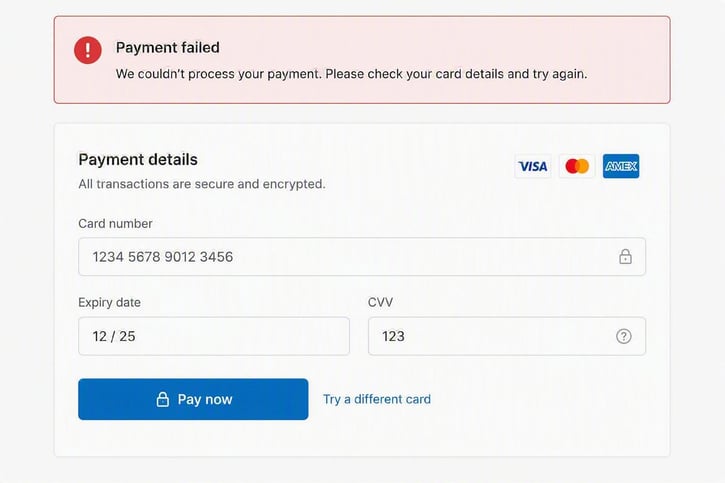
Multiple payment methods
Having multiple payment methods on file gives you more flexibility when recovering failed payments. If one method fails, the system can retry the payment using an alternative option, such as a different card or a bank account.
This reduces reliance on a single payment source and increases the chances of successful collection. It also gives customers more control over how they pay, which can help reduce friction and improve retention over time.
A better way to manage billing
Work with a platform powered by Ezypay, or bring your own solution and integrate directly with Ezypay to support payments end to end.
With the right setup:
- Payments run in the background
- Failed payments are recovered automatically
- Customers stay on track without friction
- Revenue becomes more predictable
That is how you reduce churn and keep growth moving.
Discover friction free failed payment handling
Talk to Us
Share:


Recent Posts
Tips & Tricks
Payments
Blogs
 Health & Fitness
Payments
GCash
Health & Fitness
Payments
GCash
 Trends
Blogs
Trends
Blogs